
Why prompt design is not a technical skill, but an emergent genre of teaching and learning
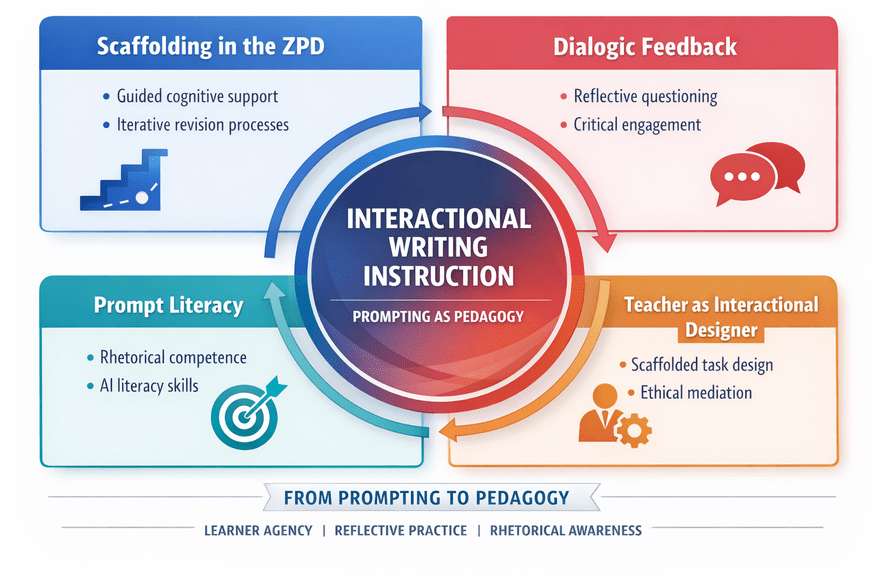
The rapid integration of generative artificial intelligence (GenAI) into language education has brought the practice of prompting to the centre of contemporary writing pedagogy. While prompting is often framed as a technical means of eliciting better outputs from large language models, its educational significance is far deeper. In AI-mediated writing contexts, prompts increasingly function as a new pedagogical genre: they structure interaction, shape revision practices, and influence how learners engage with language, feedback, and authorship.
This shift is particularly consequential when situated within sociocultural theories of writing development, which emphasise that learning emerges through mediated activity, dialogue, and scaffolded participation rather than through isolated textual production (Vygotsky, 1978). From this perspective, prompts cannot be treated as neutral inputs or instrumental commands. Instead, they operate as instructional moves that direct learner attention, frame rhetorical expectations, and organise the cognitive work of composing and revising. Prompt design therefore reflects implicit theories of language learning and writing development, encoding assumptions about what constitutes improvement, agency, and communicative competence.
Accordingly, this article argues that prompting must be conceptualised and taught not as a procedural digital skill, but as a form of rhetorical and pedagogical competence that is increasingly central to interactional writing instruction in the age of generative AI.
Prompting as Instructional Moves
From a sociocultural perspective, learning is not the result of isolated exposure to information, but of participation in mediated activity shaped by cultural tools, interaction, and scaffolding. Vygotsky’s (1978) foundational account of cognitive development emphasises that higher-order learning emerges through social mediation, as learners gradually internalise the forms of reasoning and language practices made available through interaction. Within AI-supported writing environments, prompting can be understood as one such mediational tool: it structures the learner’s engagement with language, frames the task space, and guides the kinds of cognitive and rhetorical work that revision entails.
Prompts therefore function less as technical commands and more as instructional moves that shape what learners attend to and how they conceptualise writing improvement. A prompt may direct attention toward grammatical accuracy, argumentative coherence, register, audience awareness, or genre conventions, thereby implicitly defining what counts as legitimate progress within a given writing task. In this sense, prompting operates analogously to teacher questioning in dialogic pedagogy: it initiates interaction, scaffolds reflection, and positions the learner within particular epistemic expectations about writing and revision.
Crucially, this pedagogical framing suggests that prompts are not neutral. They organise interactional space and redistribute agency between learner and tool, influencing whether the learner remains an active decision-maker or becomes a passive recipient of automated textual solutions. Prompting, then, is best understood not as a peripheral digital skill but as an emergent form of interactional instruction through which writing development is mediated, shaped, and potentially transformed in GenAI-supported classrooms.
Prompt Design and Implicit Theories of Learning
Prompt design in AI-mediated writing environments is not a neutral or technical act; it implicitly encodes assumptions about how students learn, what constitutes writing competence, and how feedback should be used to support rhetorical development. Recent research in educational technology and AI literacy highlights that the quality of interactions with generative models is directly shaped by users’ ability to formulate meaningful prompts, and that AI literacy is closely associated with more strategic and evaluative prompt use (Knoth, 2024). From an instructional perspective, prompts are therefore pedagogical levers that direct learners’ attention toward particular dimensions of writing performance.
In writing pedagogy, the rhetorical decisions embedded in prompt design reflect implicit theories of learning. Prompts emphasising surface correction often assume that writing develops through discrete error repair, whereas prompts foregrounding argumentation, audience orientation, or genre awareness align more closely with higher-order models of writing development. Systematic reviews of prompt engineering in higher education confirm that prompts shape learning outcomes most effectively when aligned with clear pedagogical goals and domain-specific criteria (Lee, 2025). Prompt design thus becomes a site where instructional ideologies are enacted, shaping how learners conceptualise writing improvement and revision responsibility.
Empirical work further suggests that generative AI functions as a mediating artefact within the writing activity system, influencing learner strategy and revision behaviour in complex ways (Wang, 2024). Understanding prompt design as pedagogically consequential therefore underscores the need for deliberate mediation: teachers must not only craft prompts but make explicit the learning rationales and rhetorical expectations they encode.
Scaffolding Within the Zone of Proximal Development
A sociocultural understanding of writing development emphasises that learning is fundamentally mediated through interaction, tools, and guided participation rather than through isolated textual production. Vygotsky’s (1978) concept of the Zone of Proximal Development (ZPD) remains central here, describing the developmental space in which learners can perform beyond their independent capacity when supported through scaffolding. Within AI-mediated writing environments, prompting can be reconceptualised as a form of mediated action that either sustains or collapses this developmental zone, depending on how interaction is structured.
When prompts are designed to elicit reflection, evaluation, and decision-making, they can function as scaffolds that extend learner agency and promote higher-order engagement with writing. Emerging research on generative AI-assisted writing suggests that students engage most productively when AI is integrated into iterative drafting processes that preserve learner responsibility for meaning-making and revision strategy (Wang, 2024).
Conversely, prompts that request full rewrites or automated textual replacement risk bypassing the cognitive labour through which writing competence develops. Kasneci et al. (2023) caution that generative systems, while often educationally useful, can easily produce over-reliance and passive dependence if pedagogical structures do not foreground learner judgement and developmental participation. Prompting must therefore sustain the ZPD by scaffolding writing activity rather than outsourcing authorship.
Dialogic Feedback and Interactional Prompting
Contemporary feedback scholarship increasingly rejects transmission-based models in which feedback is treated as a unidirectional delivery of corrective information. Instead, feedback is now widely understood as a dialogic process requiring learner interpretation, evaluative judgement, and active engagement in revision. Carless and Boud (2018) emphasise that feedback becomes educationally meaningful only when learners develop the literacy to make sense of comments and translate feedback into sustained improvement.
Within GenAI-supported writing environments, prompting becomes one of the primary mechanisms through which such interaction is structured. Prompts do not simply trigger responses from a model; they shape the feedback relationship itself by determining whether learners engage dialogically with suggestions or passively consume automated revisions. Prompting that invites comparison, questioning, or critique can position AI feedback as an object of deliberation rather than an authoritative endpoint.
UNESCO’s guidance similarly stresses that AI integration must strengthen critical capacity and learner autonomy rather than encourage automation-driven learning (UNESCO, 2023). Selwyn et al. (2025) further observe that teachers increasingly manage the pedagogical frailties introduced by generative tools, including inaccuracies, normativity, and learner over-reliance. These findings underscore that dialogic prompting is not optional but necessary for sustaining formative revision ecologies.
Prompt Literacy as Rhetorical and Pedagogical Competence
The increasing presence of generative AI in writing contexts necessitates a rethinking of literacy itself. Prompting cannot be reduced to a procedural competence aimed at producing better outputs. Rather, prompt literacy constitutes an emergent rhetorical practice through which learners articulate communicative intentions, specify evaluative criteria, and negotiate meaning with an algorithmic interlocutor.
Knoth (2024) demonstrates that AI literacy is associated with deeper engagement in evaluative and strategic interaction with generative systems. Similarly, Lee’s (2025) systematic review confirms that prompts shape learning outcomes most productively when aligned with pedagogical intent and reflective task design. In writing pedagogy, this rhetorical dimension is especially salient because prompts frame audience, stance, genre, and epistemic positioning.
Accordingly, prompt literacy must be treated as a pedagogical object in its own right. Teachers must support learners in prompting as writers: formulating purposeful questions, requesting feedback that invites reasoning rather than replacement, and evaluating AI suggestions critically in relation to communicative goals. UNESCO (2023) similarly stresses that AI integration must protect learner agency and critical capacity, underscoring the need for prompt practices grounded in discernment and epistemic responsibility.
The Teacher’s Role as Interactional Designer
The integration of generative AI into writing pedagogy does not diminish the role of the teacher; rather, it intensifies teacher responsibility in qualitatively new ways. As prompting becomes central to AI-mediated feedback and revision, the teacher’s role shifts toward designing the interactional conditions under which writing development remains formative and agentive.
Teachers therefore emerge as interactional designers who orchestrate when, how, and for what purposes AI systems are engaged. Luckin et al. (2022) describe this capacity as central to AI readiness: professional competence grounded in judgement, mediation, and pedagogical governance. Selwyn et al. (2025) similarly highlight that teachers increasingly manage not only AI outputs but the vulnerabilities they introduce, including passive compliance and normative pressures.
UNESCO (2023) stresses that generative AI must be integrated in ways that preserve learner autonomy and the human-centred purposes of education. Prompting thus becomes part of teacher expertise precisely because it structures epistemic participation in writing. The rise of prompting signals not the automation of writing instruction, but the emergence of a new domain of mediated pedagogy in which teacher judgement remains indispensable.
Conclusion
Prompting is rapidly emerging as a defining practice of AI-mediated writing instruction. To treat it as a technical skill is to overlook its pedagogical significance. Prompts are instructional moves, scaffolding structures, and rhetorical acts that shape learner agency, feedback engagement, and epistemic responsibility.
In the evolving ecology of GenAI-supported writing, the central question is no longer simply what feedback is provided, but how interaction is designed. Prompt literacy must therefore be understood as a core component of contemporary L2 writing pedagogy: an emergent genre of mediated instruction requiring theoretical grounding, dialogic awareness, and ethical teacher mediation.
References
Carless, D., & Boud, D. (2018). The development of student feedback literacy: Enabling uptake of feedback. Assessment & Evaluation in Higher Education, 43(8), 1315–1325.
Kasneci, E., Sessler, K., Küchemann, S., Bannert, M., Dementieva, D., Fischer, F., Gasser, U., Groh, G., Günnemann, S., Hüllermeier, E., Krusche, S., Kutyniok, G., Michaeli, T., Nerdel, C., Pfeffer, J., Poquet, O., Sailer, M., Schmidt, A., Seidel, T., … Kasneci, G. (2023). ChatGPT for good? On opportunities and challenges of large language models for education. , 102274.
Knoth, N. (2024). AI literacy and its implications for prompt engineering in higher education. Computers and Education: Artificial Intelligence, 5, 100168.
Luckin, R., Holmes, W., Griffiths, M., & Forcier, L. B. (2022). Empowering educators to be AI-ready. Computers and Education: Artificial Intelligence, 3, 100080.
Selwyn, N., Ljungqvist, M., & Sonesson, A. (2025). When the prompting stops: Exploring teachers’ work around the educational frailties of generative AI tools. Learning, Media and Technology.
UNESCO. (2023). Guidance for generative AI in education and research. United Nations Educational, Scientific and Cultural Organization.
Vygotsky, L. S. (1978). Mind in society: The development of higher psychological processes. Harvard University Press.
Wang, C. (2024). Exploring students’ generative AI-assisted writing processes: AI as a mediating artefact in revision activity.

 The Meta Linguist
You must be logged in to post a comment.