
Introduction: A Foundational Assumption Under Pressure
Few assumptions have been more deeply embedded within writing pedagogy than the belief that writing develops through revision. Across cognitive, sociocultural, and process-oriented traditions of writing research, drafting has long been understood not merely as a mechanism for producing text but as a mechanism for producing thought. Writers generate ideas, encounter limitations, identify weaknesses, reformulate arguments, and gradually transform preliminary formulations into more sophisticated expressions. Within this developmental sequence, revision functions as far more than textual correction. It constitutes one of the primary sites through which linguistic knowledge, rhetorical awareness, metacognitive control, and disciplinary thinking emerge.
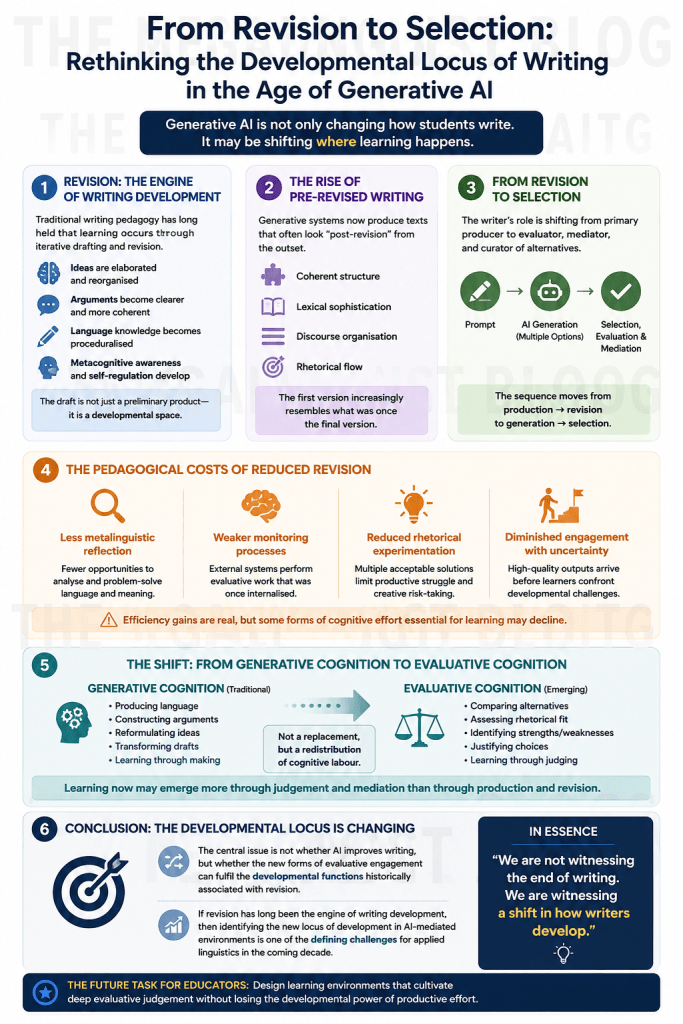
The rise of generative language technologies introduces a challenge that extends beyond questions of authorship, plagiarism, or academic integrity. Increasingly, learners begin the writing process not with an incomplete draft but with a linguistically sophisticated text generated through interaction with a large language model. These texts frequently display levels of coherence, lexical sophistication, structural organisation, and rhetorical fluency that previously emerged only after multiple rounds of drafting and revision. The first version increasingly resembles what was once the final version.
This development raises a question that remains largely absent from contemporary discussions of AI-mediated writing. If revision has historically functioned as one of the principal mechanisms through which writing development occurs, what happens when revision is no longer the dominant activity within the writing process? More fundamentally, what happens when the developmental locus of writing begins to shift? The issue is not simply that learners may revise differently. The deeper possibility is that the cognitive processes through which writing development occurs are themselves being reorganised.
This article argues that generative technologies are transforming not merely how students write but where learning occurs within the writing process. The most significant educational consequence may not be the automation of textual production. Rather, it may be the gradual displacement of revision as the central cognitive engine of writing development. In its place emerges a different developmental configuration organised less around the transformation of self-generated language and more around the evaluation, mediation, and selection of externally generated possibilities.
Revision as the Engine of Writing Development
The centrality of revision within writing theory is neither accidental nor merely procedural. Since the emergence of process-oriented approaches to writing, revision has been understood as a cognitive activity through which writers reorganise ideas, clarify intentions, negotiate meanings, and refine conceptual understanding. Flower and Hayes (1981) conceptualised writing as a recursive process involving planning, translating, and reviewing, emphasising that writers move repeatedly between these activities rather than progressing through them linearly. Within this framework, revision functions not as a final stage but as an integral component of thinking itself.
Subsequent scholarship reinforced this perspective. Bereiter and Scardamalia (1987) distinguished between knowledge-telling and knowledge-transforming models of writing, arguing that more sophisticated writers engage in iterative cycles of problem-solving through which ideas themselves are restructured. Revision becomes the mechanism through which writers move beyond transcription and toward conceptual development. The significance of this process extends beyond textual improvement. It contributes directly to the development of disciplinary reasoning, rhetorical awareness, audience sensitivity, and metacognitive regulation.
Importantly, revision is not a singular activity. It encompasses multiple dimensions operating simultaneously. Writers revise language, but they also revise ideas. They revise organisation, argumentation, stance, audience awareness, and conceptual understanding. Some forms of revision involve local linguistic adjustments, while others involve substantial rethinking of meaning itself. This distinction is increasingly important because emerging technologies may influence these dimensions unevenly. Surface-level editing may become increasingly automated, whereas deeper evaluative and strategic forms of revision may persist or even become more significant.
From a pedagogical perspective, revision performs a uniquely developmental function because it compels learners to engage with uncertainty. Writers must evaluate alternatives, identify weaknesses, justify modifications, and reconcile competing rhetorical possibilities. These activities demand simultaneous engagement with linguistic form, communicative purpose, and audience expectations. The draft therefore functions not merely as a preliminary product but as a developmental space in which learning becomes possible.
This distinction explains why revision occupies such a privileged position within writing pedagogy. Its value lies not primarily in producing better texts but in producing more sophisticated writers. The educational significance of revision derives from the cognitive work it requires and the developmental opportunities it creates.
The Rise of Pre-Revised Writing
Generative language technologies alter this relationship in a fundamental way. Unlike earlier writing technologies, which primarily assisted with localised linguistic features such as spelling or grammar, contemporary systems generate complete textual structures. They routinely produce organised arguments, coherent discourse progression, sophisticated vocabulary, and rhetorically effective formulations within seconds.
The consequence is the emergence of what may be described as pre-revised writing. Texts increasingly arrive already exhibiting many of the characteristics that revision has traditionally sought to achieve. Logical sequencing, lexical variation, paragraph organisation, stylistic consistency, and rhetorical coherence often appear in the initial output rather than emerging through iterative refinement.
At first glance, this development appears entirely beneficial. Learners gain access to higher-quality textual models, overcome linguistic obstacles more efficiently, and produce more polished work. Yet these apparent advantages obscure a deeper pedagogical transformation. If many of the outcomes traditionally produced through revision are now available at the beginning of the writing process, the developmental role of revision itself becomes less clear.
The issue is not that revision disappears entirely. Rather, its function becomes reconfigured. Historically, revision involved transforming imperfect language into more effective language through cycles of reflection and reformulation. Increasingly, it involves evaluating already fluent alternatives. The writer no longer necessarily confronts the challenge of generating rhetorical solutions but instead confronts the challenge of selecting among them.
This shift has implications that extend beyond textual production. It alters the distribution of cognitive labour within the writing process itself. Activities that were once embedded within drafting and revision may increasingly be displaced toward evaluation and selection.
From Revision to Selection
Perhaps the most significant consequence of generative writing technologies is the emergence of selection as a dominant literacy practice. Historically, writing followed a broadly developmental trajectory. Writers produced language, identified weaknesses, revised formulations, and gradually improved both text and understanding. Production preceded evaluation.
Generative environments increasingly disrupt this sequence. Multiple formulations, structures, arguments, and lexical choices become available before the learner has fully engaged in the process of generating them. The primary task becomes selecting among alternatives rather than producing them.
This transformation alters the nature of writerly activity in ways that are more profound than they initially appear. The learner increasingly occupies the role of evaluator, mediator, and curator of linguistic possibilities rather than that of primary linguistic producer. The educational significance of this shift extends beyond questions of authorship. It suggests a redistribution of cognitive labour within the writing process itself.
Such a shift has important implications for theories of writing development. Existing models largely assume that learning emerges through iterative cycles of production and revision. Selection, however, requires a different constellation of cognitive operations. It emphasises comparison, prioritisation, critical evaluation, rhetorical judgement, and decision-making. While these processes are undoubtedly valuable, they are not necessarily equivalent to those traditionally associated with revision.
The educational question is therefore not whether selection constitutes a meaningful activity. It clearly does. The more important question is whether selection cultivates the same forms of expertise that revision has historically fostered, or whether it produces a different kind of writer altogether.
The Pedagogical Costs of Reduced Revision
The reduction of revision as a central activity may carry consequences that extend beyond textual production. Revision requires writers to confront uncertainty, identify limitations, tolerate ambiguity, and engage in sustained reflection on language and meaning. These processes contribute to the development of metalinguistic awareness, self-monitoring capacity, and rhetorical flexibility.
When algorithmic systems generate sophisticated alternatives before learners encounter such difficulties, opportunities for productive struggle may diminish. Writers are presented with solutions before fully engaging with the problems those solutions are intended to address. Linguistic uncertainty becomes increasingly short-lived. Rhetorical experimentation may be reduced because multiple acceptable formulations are immediately available. Monitoring processes become less visible because the system performs many evaluative functions automatically.
This observation should not be interpreted as a rejection of technological support. Rather, it highlights a tension between efficiency and development. Educational technologies often seek to reduce cognitive effort. Yet substantial evidence suggests that effortful engagement contributes significantly to durable learning and transfer (Bjork et al., 2013). The challenge lies in determining which forms of cognitive effort remain educationally valuable and which can be meaningfully delegated.
The concern is therefore not that learners revise less. It is that certain forms of developmental engagement historically embedded within revision may become less frequent, less visible, or less necessary.
The Shift from Generative Cognition to Evaluative Cognition
The most important question emerging from this transformation concerns the future location of learning itself. If revision no longer functions as the primary site of writing development, where does development occur?
A productive way of approaching this question is through a distinction between generative cognition and evaluative cognition. Historically, writing development has relied heavily on generative cognition. Writers developed expertise through producing language, constructing arguments, reformulating ideas, and repeatedly transforming preliminary thoughts into increasingly sophisticated forms. The cognitive effort involved in generating text functioned simultaneously as a mechanism for learning.
Increasingly, however, learners may be developing through evaluative cognition. Rather than generating every formulation themselves, they engage in comparing alternatives, assessing rhetorical appropriateness, identifying weaknesses, justifying selections, and mediating between competing possibilities. Learning emerges through judgement rather than production.
This shift should not be understood as a simple decline in cognitive engagement. Evaluative cognition requires its own forms of expertise. Effective evaluation depends upon rhetorical awareness, audience sensitivity, linguistic knowledge, and critical reasoning. The learner must determine not merely whether a formulation is grammatically acceptable, but whether it is contextually appropriate, rhetorically effective, and communicatively aligned with intended purposes.
The crucial question is not whether generative cognition or evaluative cognition is superior. Rather, it is whether they cultivate different forms of expertise. Traditional writing pedagogy has largely been built around the assumption that learning emerges through production and revision. AI-mediated environments suggest that learning may increasingly emerge through evaluation and mediation.
This possibility has profound implications for writing theory. The developmental centre of gravity may be shifting. What has historically been learned through generation may increasingly be learned through judgement.
Conclusion: Rethinking the Developmental Locus of Writing
Much of the contemporary discussion surrounding generative technologies has focused on questions of authorship, originality, and academic integrity. While important, these concerns may obscure a more consequential transformation occurring within the writing process itself. The central issue is not simply that learners have access to increasingly sophisticated textual support. It is that one of the foundational mechanisms through which writing development has traditionally occurred may be undergoing substantial reconfiguration.
Revision has historically occupied a privileged position within writing pedagogy because it constitutes one of the principal mechanisms through which language, thought, and rhetorical awareness develop simultaneously. The significance of generative technologies therefore lies not simply in their capacity to accelerate textual production, but in their potential to redistribute the cognitive work traditionally embedded within revision. As learners increasingly engage with pre-generated alternatives, the developmental centre of gravity may shift from production toward evaluation, from reformulation toward selection, and from linguistic generation toward judgement.
The most important question facing language education is therefore not whether generative technologies improve writing. It is whether the emerging forms of evaluative engagement that they promote can fulfil the developmental functions historically associated with revision. The future of writing pedagogy may ultimately depend on understanding this transformation. If revision has long served as the primary engine of writing development, then identifying the new locus of development in AI-mediated environments becomes one of the defining intellectual challenges confronting applied linguistics in the coming decade.
About the author: Ioanna N. Sakali is a Greek-Canadian, EPSO-certified linguist and PhD candidate in Computational Linguistics at the Aristotle University of Thessaloniki, with professional experience across high-stakes institutional settings, including the United Nations and the European Parliament.
References
Bereiter, C., & Scardamalia, M. (1987). The psychology of written composition. Lawrence Erlbaum Associates.
Bjork, R. A., Dunlosky, J., & Kornell, N. (2013). Self-regulated learning: Beliefs, techniques, and illusions. Annual Review of Psychology, 64, 417–444. https://doi.org/10.1146/annurev-psych-113011-143823
Flower, L., & Hayes, J. R. (1981). A cognitive process theory of writing. College Composition and Communication, 32(4), 365–387. https://doi.org/10.2307/356600
Hayes, J. R. (2012). Modeling and remodeling writing. Written Communication, 29(3), 369–388. https://doi.org/10.1177/0741088312451260
Hyland, K. (2019). Second language writing (2nd ed.). Cambridge University Press.
Kellogg, R. T. (2008). Training writing skills: A cognitive developmental perspective. Journal of Writing Research, 1(1), 1–26. https://doi.org/10.17239/jowr-2008.01.01.1
Manchón, R. M. (2011). Learning-to-write and writing-to-learn in an additional language. John Benjamins.
Myhill, D., & Jones, S. (2015). Conceptualising metalinguistic understanding in writing. Culture and Education, 27(4), 839–867. https://doi.org/10.1080/11356405.2015.1089387


You must be logged in to post a comment.