
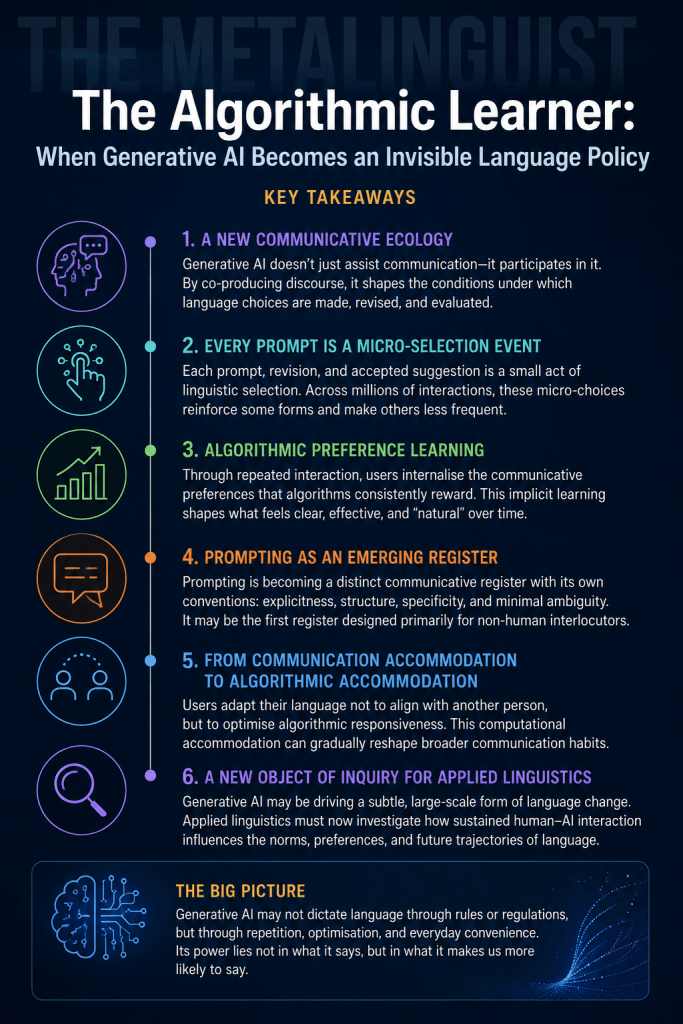
Introduction: Who Is Adapting to Whom?
Languages have never evolved independently of the environments in which they are used. Across history, educational institutions, publishing practices, technological infrastructures, and social communities have shaped which linguistic forms become standard, which rhetorical conventions acquire prestige, and which communicative practices gradually recede. Standardisation has therefore rarely emerged through explicit regulation alone. More often, it has developed through repeated participation in communicative environments that reward particular forms of language over competing alternatives (Milroy & Milroy, 2012).
Generative AI introduces a fundamentally new communicative environment. Unlike previous language technologies, it does not merely store, transmit, or facilitate communication. It actively generates discourse while simultaneously shaping the interactional conditions under which language is produced, revised, and evaluated. This dual role raises a question that remains insufficiently examined within applied linguistics: can generative systems influence language not through explicit prescription, but through the cumulative optimisation of everyday communicative behaviour?
Much of the current discussion assumes that humans are learning to use AI. This article advances the reverse perspective. It argues that prolonged interaction with generative systems may gradually encourage language users to internalise the communicative preferences embedded within those systems. The educational significance of this possibility extends well beyond writing assistance. It suggests that generative AI may be beginning to function as an emergent mechanism of linguistic norm formation: a largely invisible force shaping which linguistic behaviours become easier, more efficient, more rewarded, and therefore more likely to be reproduced.
Generative AI as a New Communicative Ecology
Technological innovation has always influenced language use, but previous technologies occupied a different position within the communicative process. The printing press contributed to orthographic standardisation, word processors transformed revision practices, and search engines altered information retrieval. Yet these technologies primarily mediated communication without participating directly in discourse generation. Spellcheckers corrected orthography, search engines facilitated access to information, and word processors changed the material conditions of revision, but the responsibility for lexical selection, rhetorical organisation, argument construction, and textual coherence remained primarily with the writer.
Generative language models alter this relationship in a decisive way. Rather than simply supporting writing, they increasingly participate in it by proposing arguments, recommending discourse structures, reformulating sentences, anticipating lexical choices, and producing stylistically coherent text before writers have fully articulated their own intentions. Their influence therefore extends beyond mediation to co-production. They do not merely assist communication; they increasingly shape the communicative environment within which language choices are made.
This distinction matters because language continuously adapts to communicative environments. Interactional approaches have shown that speakers modify language in response to interlocutors, contexts, and communicative goals (Clark, 1996; Pickering & Garrod, 2004). Usage-based approaches similarly emphasise that repeated linguistic experiences shape cognitive representations of language and influence future production (Ellis, 2002). If generative systems become routine participants in communicative practice, they may also become part of the ecological conditions through which linguistic behaviour is stabilised, reinforced, and transmitted.
Every Prompt Is a Micro-Selection Event
The influence of generative AI is unlikely to emerge through overt linguistic prescription. Instead, it operates through ordinary interactions that appear individually insignificant yet become collectively consequential. Every prompt submitted, every suggested revision accepted, every regenerated paragraph preferred over another, and every algorithmic recommendation incorporated into a final text constitutes a small act of linguistic selection.
Viewed in isolation, such decisions appear trivial. Viewed across millions of daily interactions, however, they represent a continuous process through which certain linguistic forms are repeatedly reinforced while others become progressively less available, less efficient, or less likely to be reproduced. Unlike traditional language planning, this process does not rely on institutional regulation or explicit norms. It operates through optimisation. Users gradually discover which communicative strategies consistently produce more satisfactory responses and begin reproducing those strategies with increasing regularity.
This phenomenon may be understood as algorithmic preference learning. The concept does not imply that users consciously imitate AI-generated language. Rather, it suggests that repeated interaction with generative systems may gradually increase the probability that particular linguistic behaviours become cognitively accessible, communicatively efficient, and therefore more likely to be reproduced across subsequent contexts. Human communication has always involved the internalisation of expectations acquired through interaction with teachers, disciplinary communities, professional cultures, and social networks. Generative AI introduces an additional source of preference formation: one grounded not in interpersonal negotiation, but in repeated adaptation to computational responsiveness.
Prompting as an Emerging Communicative Register
One of the most significant consequences of generative AI is the emergence of prompting as a distinct communicative register. Registers have traditionally been understood as varieties of language associated with recurring communicative situations, each characterised by relatively stable lexical, syntactic, pragmatic, and rhetorical conventions (Biber & Conrad, 2009). Academic writing, legal discourse, scientific communication, and everyday conversation all exhibit recognisable register-specific features shaped by their communicative purposes.
Prompting increasingly demonstrates similar characteristics. Effective prompts favour explicitness over implication, procedural sequencing over narrative development, lexical specificity over contextual inference, and direct instruction over rhetorical subtlety. Ambiguity, indirectness, ellipsis, irony, and implicit assumptions frequently reduce the predictability of generated responses and are therefore progressively avoided. In this sense, prompting may represent one of the first communicative registers developed primarily for interaction with non-human interlocutors.
This makes prompt discourse historically distinctive. Unlike academic, legal, or scientific registers, which evolved to facilitate communication among specialised human communities, prompting evolves to optimise interaction with computational systems. Its conventions arise not from shared social identity or disciplinary membership, but from the repeated discovery of what makes machine-generated responses more usable, coherent, and predictable.
The significance of this emerging register extends beyond human–machine interaction. As users repeatedly engage with its communicative conventions, these linguistic habits may become cognitively efficient and increasingly automatic. The concern is not simply that people write differently when interacting with AI. Rather, repeated participation in algorithmically optimised communication may gradually influence how they write in broader educational and professional contexts. Prompting therefore represents more than a new interactional technique; it may constitute a mechanism through which computational systems influence everyday language use.
From Communication Accommodation to Algorithmic Accommodation
Communication Accommodation Theory proposes that speakers routinely modify aspects of their language in response to interlocutors in order to facilitate interaction, establish rapport, negotiate social relationships, or manage social distance (Giles et al., 1991). Traditionally, accommodation has been understood as an interpersonal phenomenon. Speakers converge linguistically because communication is shaped by social identity, mutual intelligibility, and relational positioning.
Generative AI introduces a qualitatively different form of accommodation. Increasingly, language users adjust their communicative behaviour not to align with another speaker’s linguistic style, but to maximise the responsiveness of an algorithmic system. They simplify syntax, reduce ambiguity, organise information sequentially, foreground explicit instruction, and adopt increasingly standardised communicative strategies because experience demonstrates that such forms consistently produce more satisfactory outputs.
This process may be described as algorithmic accommodation. Unlike interpersonal accommodation, it is not motivated by affiliation, identity negotiation, or social rapport, but by computational optimisation. Nevertheless, its linguistic consequences may be significant. Repeated accommodation to algorithmic preferences has the potential to reshape communicative habits beyond AI interaction itself, contributing to gradual convergence toward increasingly standardised discourse practices.
Conclusion: A New Object of Inquiry for Applied Linguistics
Applied linguistics has traditionally examined how language evolves through interaction among speakers, communities, institutions, and communicative practices. Generative AI introduces an additional force into this ecology: computational interaction. Although language models possess neither communicative intentions nor social identities, they increasingly shape the environments within which linguistic choices are produced, evaluated, refined, and repeated. Their influence may therefore emerge not through explicit prescription, but through the gradual accumulation of everyday communicative decisions.
The most significant consequence of generative AI may ultimately lie not in the language it generates, but in the language it encourages humans to produce. If communicative preferences acquired through repeated interaction with algorithmic systems become progressively internalised, applied linguistics may need to recognise a new mechanism of language change: one emerging not from human communities alone, but from sustained interaction between human cognition and computational discourse.
The central question therefore is no longer whether people use generative AI to write. The more consequential issue is whether prolonged interaction with generative systems gradually alters what language users come to perceive as clear, persuasive, appropriate, or even natural language. If this process is already underway, the object of inquiry is not merely machine-generated text, but the subtle emergence of algorithmically mediated language change.
About the author: Joanne Nifli-Sakali is a Greek-Canadian, EPSO-certified linguist and PhD candidate in Computational Linguistics at the Aristotle University of Thessaloniki, with professional experience across high-stakes institutional settings, including the United Nations and the European Parliament.
References
Biber, D., & Conrad, S. (2009). Register, genre, and style. Cambridge University Press.
Clark, H. H. (1996). Using language. Cambridge University Press.
Ellis, N. C. (2002). Frequency effects in language processing: A review with implications for theories of implicit and explicit language acquisition. Studies in Second Language Acquisition, 24(2), 143–188.
Giles, H., Coupland, N., & Coupland, J. (Eds.). (1991). Contexts of accommodation: Developments in applied sociolinguistics. Cambridge University Press.
Milroy, J., & Milroy, L. (2012). Authority in language: Investigating Standard English (4th ed.). Routledge.
Pickering, M. J., & Garrod, S. (2004). Toward a mechanistic psychology of dialogue. Behavioral and Brain Sciences, 27(2), 169–190.
UNESCO. (2023). Guidance for generative AI in education and research. UNESCO.
Vallor, S. (2024). The AI mirror: How to reclaim our humanity in an age of machine thinking. Oxford University Press.


You must be logged in to post a comment.