
One of the defining promises of generative AI is the removal of linguistic friction. Within seconds, learners can obtain a grammatically accurate sentence, a more precise lexical choice, a coherent paragraph, or an entire essay. From an instructional perspective, this represents a remarkable advance in access to linguistic support. From a learning perspective, however, it raises a more fundamental question: what becomes of language development when the cognitive effort required to resolve linguistic uncertainty is no longer necessary?
Much of the current debate surrounding genAI has centred on the quality of AI-generated writing, academic integrity, automated feedback, and assessment validity (Kasneci et al., 2023; Zawacki-Richter et al., 2024). These concerns are both legitimate and necessary. Yet they share a common limitation: they evaluate the products of AI-assisted writing while paying comparatively little attention to the processes that produce them. Hidden behind every completed sentence lies a series of cognitive decisions—hesitation, experimentation, revision, monitoring, and reformulation—that have historically constituted the very mechanisms through which language learning occurs.
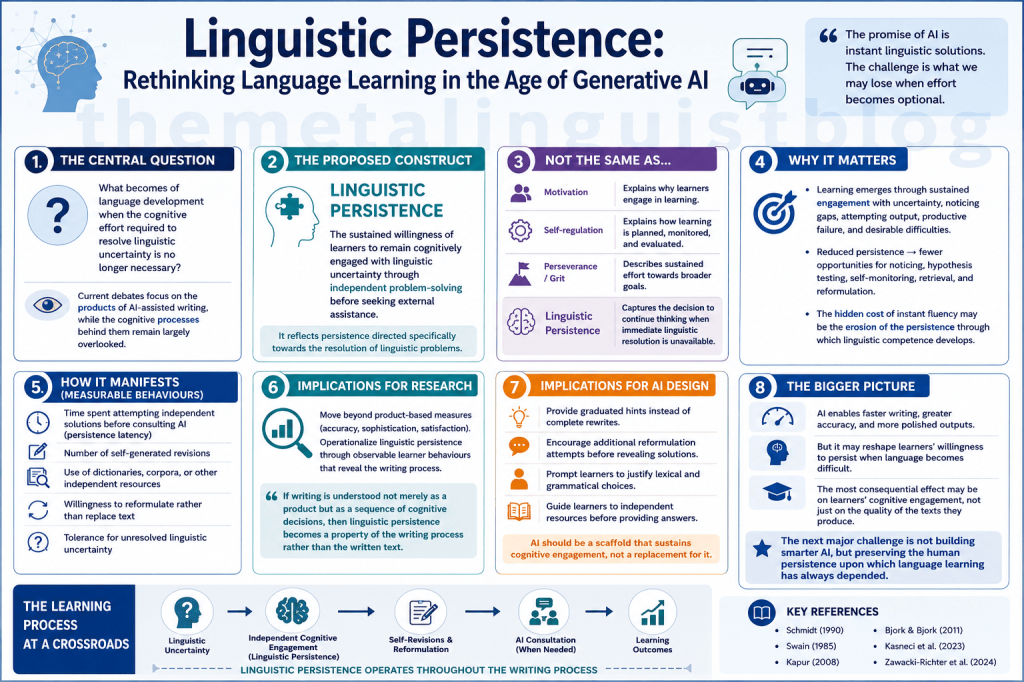
These largely invisible cognitive processes point towards a dimension of language learning that has received remarkably little theoretical attention despite its centrality to language development. This dimension can be conceptualised as linguistic persistence: the sustained willingness of learners to remain cognitively engaged with linguistic uncertainty through independent problem-solving before seeking external assistance.
The introduction of this construct is not merely terminological. Existing concepts such as motivation, perseverance, grit, and self-regulation undoubtedly capture important aspects of learner behaviour, yet none explicitly describe learners’ behavioural response to immediate linguistic uncertainty in environments where external cognitive assistance is continuously available. Generative AI has fundamentally altered this moment of decision-making. The relevant educational question is no longer whether learners possess the ability to solve linguistic problems independently, but whether they choose to engage with those problems before delegating them to AI. Linguistic persistence therefore describes a form of learner behaviour that existing theoretical frameworks only partially explain.
The distinction is important because linguistic persistence is not synonymous with motivation, perseverance, or self-regulation. Motivation explains why learners engage with learning, self-regulation explains how learning is planned, monitored, and evaluated, and perseverance describes sustained effort towards broader goals. Linguistic persistence, by contrast, captures learners’ willingness to remain cognitively engaged with unresolved linguistic problems before seeking external assistance. It is demonstrated when learners reformulate a sentence instead of requesting an AI rewrite, consult a corpus or dictionary before generating a prompt, or tolerate temporary uncertainty while searching for a more appropriate expression. In essence, it reflects persistence directed specifically towards the resolution of linguistic problems.
For decades, such behaviours were so deeply embedded within language learning that they rarely attracted theoretical attention. Learners compared collocations, consulted dictionaries, reread texts, discarded unsuccessful drafts, and experimented with alternative formulations because these activities were unavoidable. Independent linguistic problem-solving was not considered a learner characteristic; it was simply the condition under which language learning occurred. Generative AI has fundamentally altered that condition.
For the first time in the history of language education, learners are no longer required to resolve linguistic uncertainty independently before obtaining an acceptable solution. This seemingly simple technological shift fundamentally changes the cognitive ecology of writing. Independent linguistic problem-solving has moved from being an unavoidable stage of learning to an optional one. Consequently, persistence itself becomes a meaningful educational variable rather than an invisible background condition.
Today, virtually every moment of linguistic uncertainty is accompanied by an alternative: immediate completion. This behavioural shift may appear subtle, yet its implications are potentially profound. Research across second language acquisition and cognitive psychology consistently suggests that learning is rarely the product of immediate correctness alone. Rather, it emerges through sustained engagement with uncertainty, noticing linguistic gaps (Schmidt, 1990), attempting meaningful output (Swain, 1985), productive failure (Kapur, 2008), and the desirable difficulties that strengthen long-term retention (Bjork & Bjork, 2011).
The educational challenge posed by generative AI is therefore not that it makes learners less capable. Rather, it may gradually reduce their willingness to remain cognitively engaged with linguistic problems long enough for deeper learning to occur. Reduced linguistic persistence may lead to fewer opportunities for noticing, hypothesis testing, self-monitoring, retrieval, and independent reformulation—all cognitive mechanisms consistently associated with second language development. The hidden cost of instant fluency may therefore be neither declining writing quality nor diminished grammatical accuracy, but the gradual erosion of the persistence through which linguistic competence has traditionally developed.
Viewing linguistic persistence as a distinct construct also reframes how AI-assisted language learning should be investigated. Current research predominantly evaluates outcomes such as grammatical accuracy, lexical sophistication, writing quality, and learner satisfaction. While these remain valuable indicators, they reveal relatively little about the cognitive behaviours that precede successful performance. Future research could operationalise linguistic persistence through observable behaviours, including the time learners spend attempting independent solutions before consulting AI, the number of self-generated revisions they produce, their use of dictionaries or corpora, their willingness to reformulate rather than replace text, and their tolerance for unresolved linguistic uncertainty. These behavioural indicators may ultimately prove to be as informative as the linguistic quality of the finished text itself.
If writing is understood not merely as a product but as a sequence of cognitive decisions, then linguistic persistence becomes a property of the writing process rather than the written text. This perspective shifts attention from evaluating what learners ultimately produce to understanding how they arrive there. Such a shift may prove essential for assessing learning in educational environments where AI increasingly participates in the writing process itself.
The implications extend beyond research to the design of educational AI. Current systems are optimised to eliminate effort by providing rapid, comprehensive solutions. Yet educational effectiveness may sometimes require preserving effort rather than removing it. Intelligent tutoring systems could support linguistic persistence by providing graduated hints instead of complete rewrites, encouraging additional reformulation attempts before revealing solutions, prompting learners to justify lexical and grammatical choices, or directing them towards independent resources before offering answers. Such designs would position AI not as a replacement for cognitive engagement, but as a scaffold deliberately designed to sustain it.
As generative AI becomes an increasingly permanent component of language education, it is understandable that its success is measured through faster writing, greater accuracy, and more polished final products. These achievements are significant, but they may also obscure a quieter transformation occurring beneath the surface. The most consequential educational effect of generative AI may not lie in the quality of the language it produces, but in the extent to which it reshapes learners’ willingness to persist when language becomes difficult.
Generative AI has transformed the conditions under which language learning takes place. The next major challenge is therefore unlikely to involve building increasingly intelligent educational systems, but ensuring that learners continue to engage in the cognitive work from which linguistic competence ultimately emerges. Preserving linguistic persistence may prove to be as important for the future of language education as improving artificial intelligence itself.
About the author: Joanne Nifli- Sakali is a Greek-Canadian, EPSO-certified linguist and PhD candidate in Computational Linguistics at the Aristotle University of Thessaloniki, with professional experience across high-stakes institutional settings, including the United Nations and the European Parliament.
References
Bjork, R. A., & Bjork, E. L. (2011). Making things hard on yourself, but in a good way: Creating desirable difficulties to enhance learning. In M. A. Gernsbacher et al. (Eds.), Psychology and the Real World: Essays Illustrating Fundamental Contributions to Society (pp. 56–64). Worth Publishers.
Kapur, M. (2008). Productive failure. Cognition and Instruction, 26(3), 379–424.
Kasneci, E., Sessler, K., Küchemann, S., Bannert, M., Dementieva, D., Fischer, F., Gasser, U., Groh, G., Günnemann, S., Hüllermeier, E., Krusche, S., Kutyniok, G., Michaeli, T., Nerdel, C., Pfeiffer, F., Poquet, O., Sailer, M., Schmidt, A., Seidel, T., et al. (2023). ChatGPT for good? On opportunities and challenges of large language models for education. Learning and Individual Differences, 103, 102274.
Schmidt, R. (1990). The role of consciousness in second language learning. Applied Linguistics, 11(2), 129–158.
Swain, M. (1985). Communicative competence: Some roles of comprehensible input and comprehensible output in its development. In S. Gass & C. Madden (Eds.), Input in Second Language Acquisition (pp. 235–253). Newbury House.
Zawacki-Richter, O., Marín, V. I., Bond, M., & Gouverneur, F. (2024). Systematic review of research on artificial intelligence applications in higher education where ChatGPT and generative AI are reshaping teaching and learning. International Journal of Educational Technology in Higher Education, 21(1).


You must be logged in to post a comment.