
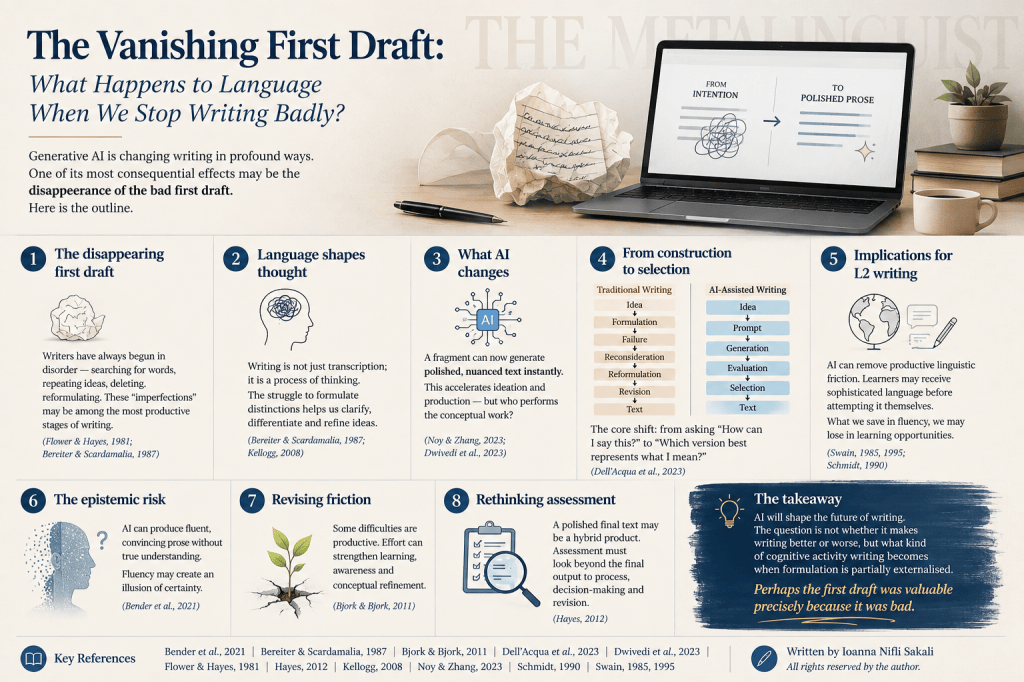
Generative AI is changing writing in ways that extend far beyond speed, accuracy or convenience. One of its most consequential effects may be surprisingly mundane: the gradual disappearance of the bad first draft. Writing has traditionally begun in linguistic disorder. Writers search for words, produce awkward sentences, repeat ideas, delete entire passages and reformulate arguments that initially fail to express what they intend. We tend to regard these moments as deficiencies to be corrected. Yet research on writing as a recursive cognitive process suggests that they may constitute one of its most productive stages (Flower & Hayes, 1981; Bereiter & Scardamalia, 1987).
Writing is not simply the transcription of thoughts that already exist in complete form. In many cases, language participates in the construction of thought itself. Writing can function as a process of knowledge transformation through which ideas become more precise in the effort to articulate them (Bereiter & Scardamalia, 1987; Kellogg, 2008). Consider a writer beginning with the vague intuition that AI makes writing easier. Turning this into an argument immediately generates questions. Easier in what sense—lexically, cognitively, rhetorically? Does assistance reduce cognitive load, or does it redistribute it? The difficulty of producing the sentence forces the writer to differentiate concepts that were previously compressed into a single intuition. The failed formulation is therefore not merely a linguistic failure. It can be part of the reasoning process itself.
Generative AI introduces a significant disruption into this sequence. A writer can now provide a fragment such as AI makes writing easier because students do not need to struggle with language and immediately receive several polished formulations: AI reduces linguistic processing demands; AI externalises aspects of lexical retrieval; AI shifts cognitive effort from formulation towards evaluation. Research on generative AI and writing has already demonstrated its capacity to accelerate and support text production across a range of professional writing tasks (Noy & Zhang, 2023; Dwivedi et al., 2023). The writer has suddenly acquired distinctions that might otherwise have emerged through several rounds of drafting. The resulting prose may be better, but an important question remains: who performed the conceptual work that made it better?
This suggests that generative AI may be transforming writing from an activity centred on linguistic construction into one increasingly organised around linguistic selection. The traditional sequence—idea, formulation, failure, reconsideration, reformulation, revision—can increasingly become idea, prompt, generation, evaluation, selection. Human agency does not disappear. Writers still accept, reject, modify and combine alternatives. Yet the locus of cognitive effort shifts. Instead of repeatedly asking How can I say this?, writers may increasingly ask Which formulation best represents what I mean? Composition begins to acquire the characteristics of curation. More broadly, research on human–AI collaboration suggests that generative systems can alter the distribution of tasks between human and machine rather than simply automate an existing process (Dell’Acqua et al., 2023).
This distinction becomes particularly significant in second-language writing. Imagine an English learner who wants to express the idea although technology helps students, too much help may prevent learning. Without AI assistance, the learner must retrieve although, negotiate the clause structure, decide among prevent, limit and interfere with, and perhaps produce several unsuccessful versions. Those difficulties expose gaps in the learner’s developing linguistic system. From the perspective of second-language acquisition, attempted production can be valuable precisely because it may encourage learners to notice the distance between what they want to express and what their current linguistic resources allow them to express (Swain, 1985, 1995; Schmidt, 1990). With generative AI, however, a sophisticated formulation can appear before the learner has attempted to construct it. The linguistic problem has been solved—but not necessarily by the learner.
We may therefore need to reconsider the assumption that reducing linguistic friction is always desirable. Educational technologies have progressively removed obstacles from composition through dictionaries, spellcheckers, grammar correction, predictive text and, now, generative AI. Yet some obstacles may constitute what we might call productive linguistic resistance. Searching for a word requires retrieval; struggling with syntax can expose incomplete grammatical knowledge; discovering that a sentence fails to express an intended meaning can force conceptual refinement. The broader concept of desirable difficulties similarly suggests that conditions that increase effort during learning can, under appropriate circumstances, enhance longer-term retention and transfer (Bjork & Bjork, 2011). A perfectly frictionless writing environment may therefore remove some of the conditions through which linguistic awareness and competence develop.
There is also an important epistemic dimension. When writers struggle to formulate an argument, they often encounter the limits of what they actually know. A sentence that refuses to become clear may reveal that the underlying thought is itself unclear. Generative AI can obscure this distinction remarkably well. Large language models are capable of producing fluent, plausible and rhetorically convincing language without guaranteeing factual reliability or human-like understanding (Bender et al., 2021). AI-assisted writing may therefore produce a particularly consequential phenomenon: linguistic fluency without equivalent epistemic certainty. The prose can signal that an argument has been resolved even when the writer’s own understanding remains incomplete.
The implications extend to writing assessment. If conventional assessment treats the final text as evidence of the writer’s linguistic and cognitive competence, AI-mediated composition complicates the relationship between textual performance and underlying ability. A polished final product may now represent a hybrid achievement distributed across human intention, machine-generated formulation and human selection. The question is therefore no longer simply whether a text is “AI-generated”. A more meaningful question may be: which components of the writing process remain diagnostically informative about the writer? As AI becomes embedded in ordinary composition, assessment may increasingly need to examine process, decision-making and revision rather than relying exclusively on the linguistic quality of the final product.
This matters because the imperfections of drafting have historically left traces of cognition. Crossed-out sentences, lexical substitutions, reorganised paragraphs and abandoned formulations reveal the movement from uncertain thought towards articulated argument. Process-oriented models of writing have long treated planning, translation and revision as recursive components of composition rather than as discrete stages culminating in correction (Flower & Hayes, 1981; Hayes, 2012). In an AI-mediated writing environment, many of these traces may disappear before they ever reach the page. The first visible sentence can already be grammatically sophisticated, rhetorically balanced and structurally complete. We gain polished language, but we potentially lose access to what might be called the linguistic archaeology of thinking.
The central question, then, is not whether AI makes writing better or worse. That binary is increasingly inadequate. The more interesting question is what kind of cognitive and linguistic activity writing becomes when formulation is partially externalised. Future writers may become highly sophisticated evaluators, editors and curators of language while performing less of its initial construction themselves. This may represent the emergence of a new literacy rather than the decline of an old one. But understanding that literacy will require us to distinguish more carefully between producing language, recognising effective language, evaluating generated language and understanding why a particular formulation works.
Perhaps, therefore, the future of writing should not aim to eliminate every moment of hesitation. There may still be educational, linguistic and intellectual value in allowing writers to inhabit the uncomfortable space between an idea and its expression before asking a machine to close it. Perhaps the first draft was valuable precisely because it was bad.
References
Bender, E. M., Gebru, T., McMillan-Major, A., & Shmitchell, S. (2021). On the dangers of stochastic parrots: Can language models be too big? Proceedings of the 2021 ACM Conference on Fairness, Accountability, and Transparency, 610–623.
Bereiter, C., & Scardamalia, M. (1987). The Psychology of Written Composition. Lawrence Erlbaum Associates.
Bjork, E. L., & Bjork, R. A. (2011). Making things hard on yourself, but in a good way: Creating desirable difficulties to enhance learning. In M. A. Gernsbacher, R. W. Pew, L. M. Hough, & J. R. Pomerantz (Eds.), Psychology and the Real World: Essays Illustrating Fundamental Contributions to Society (pp. 56–64). Worth Publishers.
Dell’Acqua, F., McFowland, E., Mollick, E. R., Lifshitz-Assaf, H., Kellogg, K. C., Rajendran, S., Krayer, L., Candelon, F., & Lakhani, K. R. (2023). Navigating the jagged technological frontier: Field experimental evidence of the effects of AI on knowledge worker productivity and quality (Harvard Business School Working Paper No. 24-013).
Dwivedi, Y. K., Kshetri, N., Hughes, L., et al. (2023). “So what if ChatGPT wrote it?” Multidisciplinary perspectives on opportunities, challenges and implications of generative conversational AI for research, practice and policy. International Journal of Information Management, 71, 102642.
Flower, L., & Hayes, J. R. (1981). A cognitive process theory of writing. College Composition and Communication, 32(4), 365–387.
Hayes, J. R. (2012). Modeling and remodeling writing. Written Communication, 29(3), 369–388.
Kellogg, R. T. (2008). Training writing skills: A cognitive developmental perspective. Journal of Writing Research, 1(1), 1–26.
Noy, S., & Zhang, W. (2023). Experimental evidence on the productivity effects of generative artificial intelligence. Science, 381(6654), 187–192.
Schmidt, R. W. (1990). The role of consciousness in second language learning. Applied Linguistics, 11(2), 129–158.
Swain, M. (1985). Communicative competence: Some roles of comprehensible input and comprehensible output in its development. In S. M. Gass & C. G. Madden (Eds.), Input in Second Language Acquisition (pp. 235–253). Newbury House.
Swain, M. (1995). Three functions of output in second language learning. In G. Cook & B. Seidlhofer (Eds.), Principle and Practice in Applied Linguistics: Studies in Honour of H. G. Widdowson (pp. 125–144). Oxford University Press.
Written by Ioanna Nifli Sakali
Ioanna N. Sakali is a Greek-Canadian, EPSO-certified linguist and PhD candidate in Computational Linguistics at the Aristotle University of Thessaloniki, with professional experience across high-stakes institutional settings, including the United Nations and the European Parliament.
All rights reserved by the author.


You must be logged in to post a comment.