
Generative artificial intelligence has transformed writing in ways that extend far beyond efficiency or textual quality. Within seconds, large language models (LLMs) can suggest vocabulary, improve grammatical accuracy, reorganise paragraphs, strengthen arguments and refine stylistic choices. While much of the current discussion has focused on AI-generated text, academic integrity and automated feedback (Kasneci et al., 2023; Zawacki-Richter et al., 2024), a more fundamental question has received comparatively little attention: what happens when writers are no longer required to solve many of the linguistic problems that writing has traditionally demanded?
Writing has never been merely a means of producing a finished text. It is a complex cognitive activity through which language is generated, monitored, revised and refined. Every sentence requires writers to select vocabulary, construct grammatical relationships, organise ideas, evaluate coherence and adjust rhetorical stance. These countless linguistic decisions are not incidental to writing; they are the very processes through which writers develop linguistic competence. If generative AI increasingly provides these solutions before writers engage with them independently, its greatest impact may not be on writing itself, but on the nature of composition.
For decades, writing research has consistently described writing as a process of problem solving rather than simple transcription. Flower and Hayes’ (1981) influential cognitive process model demonstrated that writing involves recursive planning, translating and reviewing, while Hayes (2012) further emphasised the interaction between working memory, linguistic knowledge and self-monitoring throughout composition. Although these models differ in emphasis, they share a common assumption: writing develops through the continual resolution of linguistic problems. Writers construct meaning not because language appears effortlessly, but because they repeatedly make decisions about how meaning should be expressed.
These decisions occur at every level of language. Writers search for appropriate lexical choices, compare alternative grammatical structures, select cohesive devices, organise information hierarchically and refine arguments to achieve communicative goals. Even experienced writers rarely produce polished text in a single attempt. Revision, reformulation and continual evaluation remain central features of effective writing. Composition is therefore characterised not by uninterrupted fluency but by repeated cycles of uncertainty, choice and refinement.
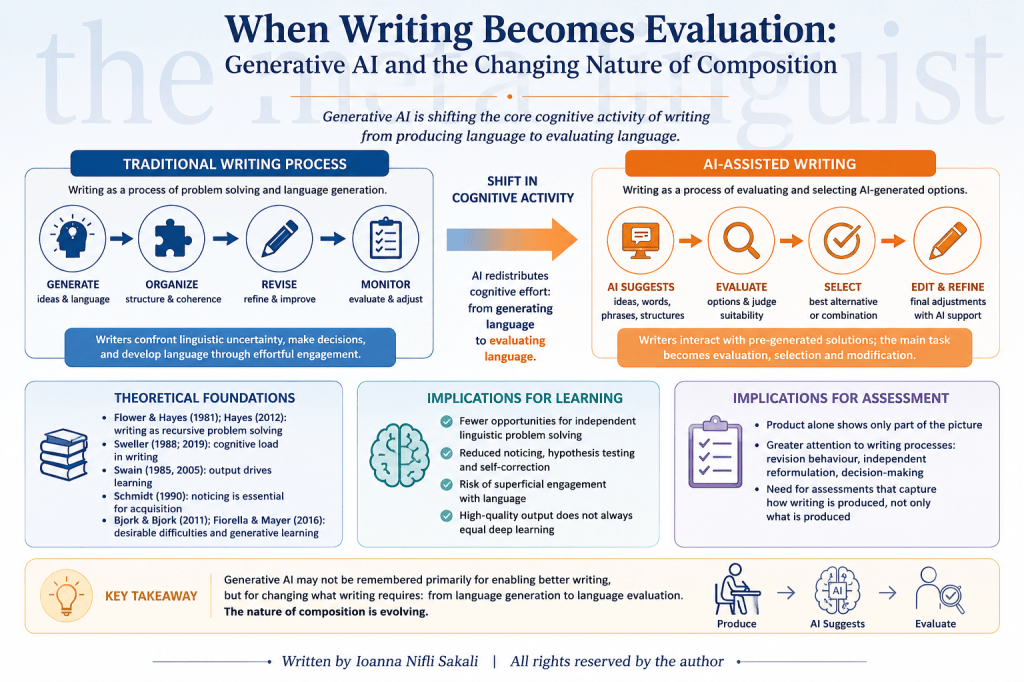
From the perspective of Cognitive Load Theory, these processes represent an essential component of the mental effort involved in writing (Sweller, 1988; Sweller et al., 2019). Working memory must simultaneously manage vocabulary retrieval, syntactic construction, discourse organisation and self-monitoring while maintaining coherence across the developing text. Although this cognitive effort makes writing demanding, it also reflects active engagement with language. Rather than simply reducing mental effort, generative AI increasingly redistributes it. Instead of generating language independently, writers often begin by evaluating, selecting and modifying linguistic alternatives that have already been produced for them.
This distinction has important implications for language learning. Swain’s Output Hypothesis (1985, 2005) argues that language production facilitates acquisition because learners must recognise gaps in their knowledge, test linguistic hypotheses and reflect on language as they attempt to express meaning. Similarly, Schmidt’s Noticing Hypothesis (1990) proposes that conscious attention to linguistic form is a necessary condition for acquisition. Both perspectives suggest that language develops through active engagement with linguistic uncertainty. When AI resolves that uncertainty before learners experience it, opportunities for noticing, experimentation and self-correction may become less frequent.
Educational psychology provides a similar perspective. Research on desirable difficulties suggests that learning activities requiring greater cognitive engagement often produce stronger long-term retention than those designed to maximise immediate performance (Bjork & Bjork, 2011). Likewise, generative learning theory argues that learners develop deeper understanding when they actively construct knowledge rather than simply receive completed solutions (Fiorella & Mayer, 2016). Within writing, the effort involved in searching for vocabulary, revising sentences and restructuring arguments is therefore not merely an obstacle to efficiency but a central mechanism through which linguistic knowledge becomes increasingly sophisticated.
Generative AI challenges this traditional relationship between writing and learning. Rather than confronting linguistic problems directly, writers increasingly interact with solutions that have already been generated. The central cognitive activity of composition consequently begins to shift. Instead of asking How can I express this idea?, writers increasingly ask Which of these alternatives should I choose? Language production gradually becomes language evaluation.
This shift should not be interpreted as an argument against the educational use of AI. Large language models provide valuable support through immediate feedback, accessible explanations and assistance with drafting and revision. They have the potential to reduce barriers to writing and expand opportunities for learning. Nevertheless, improving the quality of written products is not necessarily equivalent to supporting the cognitive processes through which language develops. A polished text produced with substantial AI assistance may involve considerably fewer opportunities for independent linguistic problem solving than a less polished text produced without external support.
This perspective also has important implications for writing assessment. Traditional assessment has understandably focused on the final product, evaluating grammatical accuracy, lexical sophistication, coherence and communicative effectiveness. As AI becomes increasingly integrated into educational contexts, however, these outcomes alone may provide only a partial picture of writing ability. Greater attention may need to be given to the processes through which texts are produced, including revision behaviour, independent reformulation and the extent to which writers actively engage with linguistic choices rather than simply accepting AI-generated alternatives.
The rapid adoption of generative AI has prompted important discussions about plagiarism, academic integrity and assessment. Yet these debates may overlook a more profound transformation. The defining characteristic of AI-assisted writing may not be that it enables better writing, but that it changes the cognitive work writing requires. Throughout history, composition has been understood as the gradual construction of language through countless acts of linguistic decision-making. As AI increasingly provides those decisions in advance, writing risks becoming less an act of language generation and more an act of language evaluation.
Whether this transformation ultimately enhances or constrains language development remains an open empirical question. What is already becoming clear, however, is that generative AI is changing more than the tools writers use. It is changing the nature of composition itself. As language production increasingly becomes language evaluation, educators and researchers may need to reconsider not only how writing is taught and assessed, but also what it means to compose independently in the age of intelligent language technologies.
References
Bjork, R. A., & Bjork, E. L. (2011). Making things hard on yourself, but in a good way: Creating desirable difficulties to enhance learning. In M. A. Gernsbacher et al. (Eds.), Psychology and the Real World (pp. 56–64). Worth Publishers.
Fiorella, L., & Mayer, R. E. (2016). Learning as a Generative Activity. Cambridge University Press.
Flower, L., & Hayes, J. R. (1981). A cognitive process theory of writing. College Composition and Communication, 32(4), 365–387.
Hayes, J. R. (2012). Modeling and remodeling writing. Written Communication, 29(3), 369–388.
Kasneci, E., Sessler, K., Küchemann, S., et al. (2023). ChatGPT for good? On opportunities and challenges of large language models for education. Learning and Individual Differences, 103, 102274.
Schmidt, R. (1990). The role of consciousness in second language learning. Applied Linguistics, 11(2), 129–158.
Swain, M. (1985). Communicative competence: Some roles of comprehensible input and comprehensible output in its development. In S. Gass & C. Madden (Eds.), Input in Second Language Acquisition (pp. 235–253). Newbury House.
Swain, M. (2005). The output hypothesis: Theory and research. In E. Hinkel (Ed.), Handbook of Research in Second Language Teaching and Learning (pp. 471–483). Lawrence Erlbaum.
Sweller, J. (1988). Cognitive load during problem solving: Effects on learning. Cognitive Science, 12(2), 257–285.
Sweller, J., van Merriënboer, J. G., & Paas, F. (2019). Cognitive architecture and instructional design: Twenty years later. Educational Psychology Review, 31(2), 261–292.
Zawacki-Richter, O., Marín, V. I., Bond, M., & Gouverneur, F. (2024). Systematic review of research on artificial intelligence applications in higher education where ChatGPT has been used. International Journal of Educational Technology in Higher Education, 21, 1–45.
About the author
Ioanna Nifli-Sakali is a Greek-Canadian, EPSO-certified linguist and PhD candidate in Computational Linguistics at the Aristotle University of Thessaloniki, with professional experience across high-stakes institutional settings, including the United Nations and the European Parliament.


You must be logged in to post a comment.